Blog · F&B ·

What makes a restaurant or cafe website different?

When opening a restaurant or cafe, or rebuilding its website, it is easy to commission the project the same way any company would. But guests search on mobile right before visiting, information is scattered across map listings, social media, and delivery apps, and reservation inquiries arrive during the busiest service hours. This post covers how restaurant and cafe website creation differs from a regular build and what to confirm before signing a contract.

One-line summary

Restaurant and cafe website creation differs from regular website creation in that it must be designed together with an information structure — menu, hours, and location — built for mobile searches right before a visit, an official-page role that anchors information scattered across map listings, social media, and delivery apps, and a flow that keeps reservation and group inquiries alive even during busy service hours.
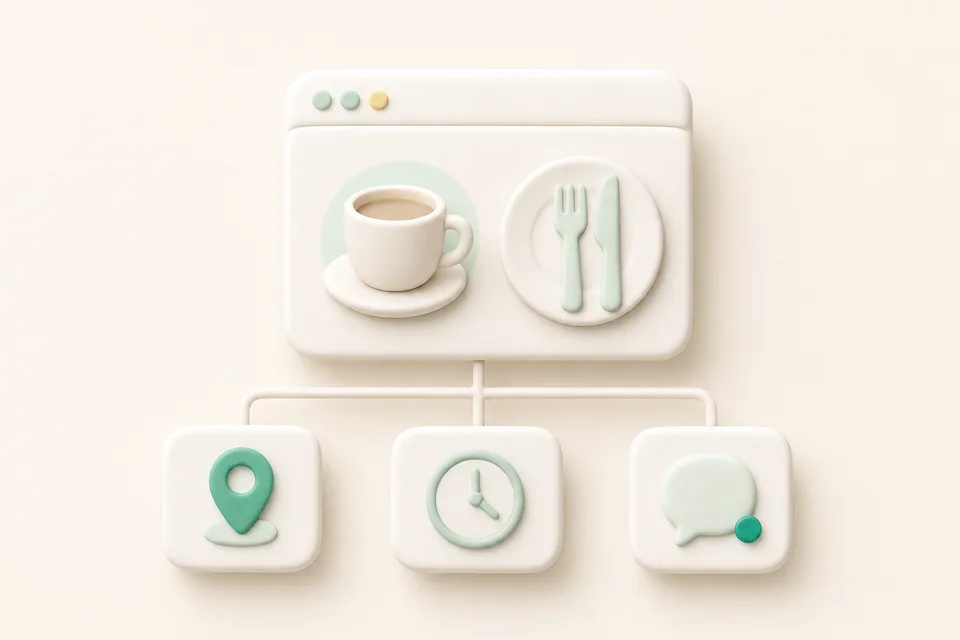
3D illustration of a browser window card marked with a coffee cup, connected to map pin, clock, and speech bubble cards, representing restaurant and cafe website creation
The differences

Where a restaurant or cafe website differs from a regular one

Guests search right before visiting

A company website is read at a desk while comparing options; a restaurant or cafe is searched on mobile, on the move or nearby. If hours, break times, the menu, and parking cannot be found within a few screens, guests give up reading and look for another place.

Information is scattered across channels

Hours and menus often live separately on map listings, social media, and delivery apps. When a closing day or a price changes and even one channel falls out of sync, guests make a wasted trip — and that experience shapes how much they trust the place.

Photos drive the decision to visit

Guests decide to visit based on menu photos and photos of the space more than on introduction copy. Reusing a text-first structure from a generic company website easily pushes the visual information that actually drives the decision below the fold.

Inquiries arrive at the busiest hours

Reservation and group inquiries come in by phone at meal times and on weekends — exactly when the kitchen and floor are busiest. A missed call moves on to another place on the spot, and an answered one stops the floor while someone handles it.

What to prepare

What to design together in a restaurant or cafe website project

An information structure for the visit decision

Arrange the menu and prices, hours with break times and closing days, location and parking, and how to book in the order guests decide to visit. The benchmark is reaching the key information within a few scrolls on a mobile screen, with menu and space photos carrying the flow.

Official information that anchors every channel

Keep map listings, social media, and delivery apps as channels where guests find you, and the website as the official reference for menu, prices, and hours. Decide what gets updated first when something changes and in what order it flows out to channels, so mismatches stay manageable as channels multiply.

A path that leads to reservations and inquiries

Answer repeat questions — hours, parking, seating — directly through site guidance, and design criteria for handing inquiries that need judgment, such as group bookings or private events, to restaurant staff. The goal is a structure where inquiries from busy hours carry over to quieter ones instead of breaking off.

A base for search and AI visibility

Organize the site so guests searching by area and menu, and guests asking AI where to go, can find it (SEO, AEO, GEO). In areas with many international visitors, per-language menu and guidance pages are designed on the same foundation.

Check yourself

Pre-build checklist for a restaurant or cafe website

  • The menu, prices, and scope of guidance for the website are organized
  • You have a rule for what gets updated first when hours or closing days change
  • Materials that drive the visit decision, such as menu and space photos, are ready
  • How reservation and group inquiries are received, and who confirms them, is decided
  • You have criteria for handling inquiries when the phone cannot be answered during service
Keep in mind

Search visibility, visitor numbers, and revenue growth cannot be guaranteed. The safe order is to build the information structure guests need to decide on a visit and the path to reservations and inquiries first, publish menu and news content after restaurant review, and read results as a trend over months.

FAQ

Common questions on this topic

Aren't map listings and Instagram enough?

Map listings and Instagram work well as channels where guests find you, but they are hard to use as the page that holds official reference information — menu, prices, and hours — in one place. With a website carrying that reference role, the restaurant gains a route to be cited in search and AI answers, and a clear anchor to fall back on when channel information drifts out of sync.

We are on delivery apps. Do we still need a website?

Delivery apps take delivery orders; they do not cover what a guest deciding on a visit looks for — hours, parking, seating, and reservations. The website serves as the official page that answers guests who search the restaurant by name and guests who visit in person, so the two cover different scopes of information.

We can't answer reservation calls during service. What do we do?

Repeat questions such as hours, parking, and seating are answered right away through site guidance and automated responses, while inquiries that need judgment — group bookings, private events — follow criteria for restaurant staff to confirm and follow up. The goal is a structure where inquiries from busy hours continue into hours when someone can respond.

Will a new website bring more guests?

Visitor numbers and search visibility cannot be guaranteed. What a website build does is create the structure where guests find the place, check the information they need to decide on a visit, and continue to a reservation or inquiry — and results are usually read as a trend over months as menu guidance and content accumulate. A consultation sets a starting scope that fits your restaurant.

Related posts

Posts that pair well with this one